The Peak of Thermodynamics: Maximum Energy Savings, Perfect Drying
Inside the gypsum boards that pass through the cutting and distribution unit and reach the kiln, there is a high amount of “free water” that has completed the hydration (hardening) reaction but must be structurally removed. Drying Technologies—the most energy-intensive and engineering-intensive stage of gypsum board production—directly determine your plant’s overall profitability.
At IPS Makina, we are not just a machine manufacturer for gypsum board production; we are a turnkey solution partner with expertise in the entire thermal process. We build advanced furnace systems that minimize natural gas/LNG consumption and prevent surface burning (yellowing) or core weakening (calcination) in the boards. At the heart of our drying technology lie three major engineering marvels:
1. Multi-Deck Dryer Architecture
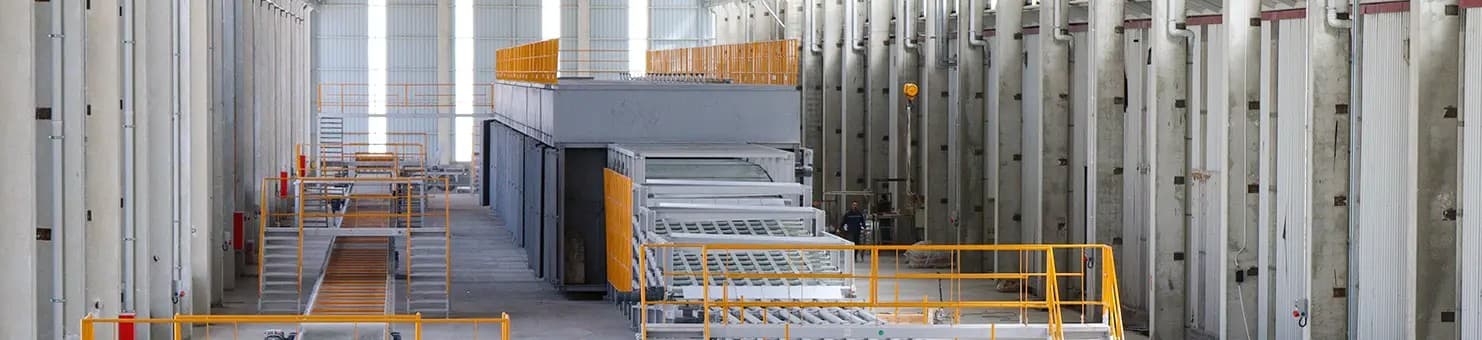
To accommodate annual capacities ranging from 5 million m² to 20 million m² and beyond, we design our drying ovens to be long in the horizontal plane and to feature a multi-deck architecture in the vertical plane.
- Zonal Drying Profile: The interior of the kiln does not consist of a single temperature; it is divided into different temperature zones along its length. When the slabs first enter the kiln (while still wet), they are exposed to high-temperature air. As the slabs move forward and the water content decreases, the temperature is gradually lowered to prevent disruption of the gypsum’s crystalline structure (chemically bound water).
- Roller Conveyor System: In our kilns, designed with 8, 10, or 12 layers, the slabs move on special heat-resistant rollers made of carbon or stainless steel. Operated by a chain-and-sprocket drive mechanism, these rollers prevent the slabs from jamming inside the kiln and ensure completely smooth movement.
- Homogeneous Airflow: Thanks to the circulation fans inside the oven, hot air flows over the panels both from below and from above (longitudinal and crosswise flow). This ensures that both surfaces and the edges of the panel dry at an equal rate, completely eliminating the risk of warping or deformation.
2. High-Efficiency Heat Exchangers
How the enormous amount of thermal energy required for drying is transferred from natural gas burners to the gypsum boards is the most critical factor determining product quality. IPS Makina kilns use specially designed heat exchangers to ensure heat uniformity and safety.
- Indirect and Safe Heating: Direct contact between the flame in the combustion chamber and the extremely high-temperature gases and the gypsum panels or oven interior equipment is prevented. Thanks to the heat exchangers, the thermal energy from the burner is perfectly transferred to the circulating air.
- Anti-Yellowing and Anti-Burning System: Since there is no direct contact with the flame and heat is transferred to the air via the heat exchangers, issues such as yellowing, scorching, or burning (over-drying) of the cardboard (paper) on the panel surface do not occur. The panels emerge from the oven snow-white and in a form that meets standards.
- Long-Lasting Heat Exchanger Tubes: Our special alloy tubes, which are resistant to high thermal shocks and feature an expanded thermodynamic surface area (finned), boost heat transfer efficiency to over 90%, significantly reducing the burners’ natural gas consumption.
3. Cascade System and Exhaust Management
The most important technology that sets IPS Makina apart in industrial plant installations is its ability to intelligently direct energy within the furnace and utilize it down to the last drop before releasing it into the atmosphere. This cycle is achieved through the Cascade System and Exhaust Management.
- Cascade Airflow System: Airflow in our furnaces is managed using an intelligent cascade logic designed to flow in a direction opposite or crosswise to the plate flow. The clean, hot air used in the furnace’s initial high-temperature zones (zones 1–2) is not vented to the outside after it has fulfilled its purpose. Since this air has cooled slightly but still retains high thermal potential, it is redirected to the oven’s subsequent zones that require lower temperatures (middle and final zones). This allows the same thermal energy to be utilized across multiple zones, resulting in massive savings of up to 20% in natural gas consumption.
- Precise Exhaust and Humidity Management: Water evaporating from the drying plates increases the humidity level of the air inside the kiln. If the air remains too humid, the plates will not dry; if the air is too dry, energy is wasted and the plates may crack. Humidity sensors and motorized exhaust dampers integrated into our SCADA system continuously monitor the humidity level inside the kiln. Only air that has reached saturation is exhausted through the exhaust flues.
- Heat Recovery from the Flue: Even the moist air discharged from exhaust flues contains latent heat. The economizer systems we offer as an option capture this waste heat to preheat the clean (fresh) combustion air entering the kiln or to heat the facility’s process water.
In our multi-story dryer, gypsum boards—which, through a marvel of thermal engineering, have shed excess water, become lighter, and achieved their final strength—pass through the cooling section and then proceed to the [Bundler and Stacking] unit, where they are prepared for packaging.